
Let’s be honest: standard banana bread is reliable, but it rarely stops conversation. However, when you introduce a warm, liquefied hazelnut-cocoa ribbon through the crumb, you transform a humble breakfast staple into a decadent pastry that rivals high-end bakeries. This isn't just about dumping chocolate into batter; it is about managing densities and hydration to create a loaf that is visually stunning and texturally complex.
I have spent years tweaking the hydration levels of quick breads. The version we are making today leverages the hygroscopic nature of brown sugar and the enzymatic breakdown of over-ripe bananas to ensure that even three days later, this loaf remains impossibly soft.
The Physics of the Crumb & The "Goo" Factor
The success of this recipe lies in the contrast between the tender, airy banana crumb and the dense, fudgy Nutella swirl. From a culinary science perspective, we are dealing with two different batters competing for space.
The banana batter relies on baking soda reacting with the acidity of the brown sugar and bananas to create carbon dioxide lift. The Nutella, however, is a fat-heavy paste that weighs down the structure. If you simply stir it in, you get a gray, muddy loaf. By layering and gently swirling, we preserve distinct pockets of flavor.
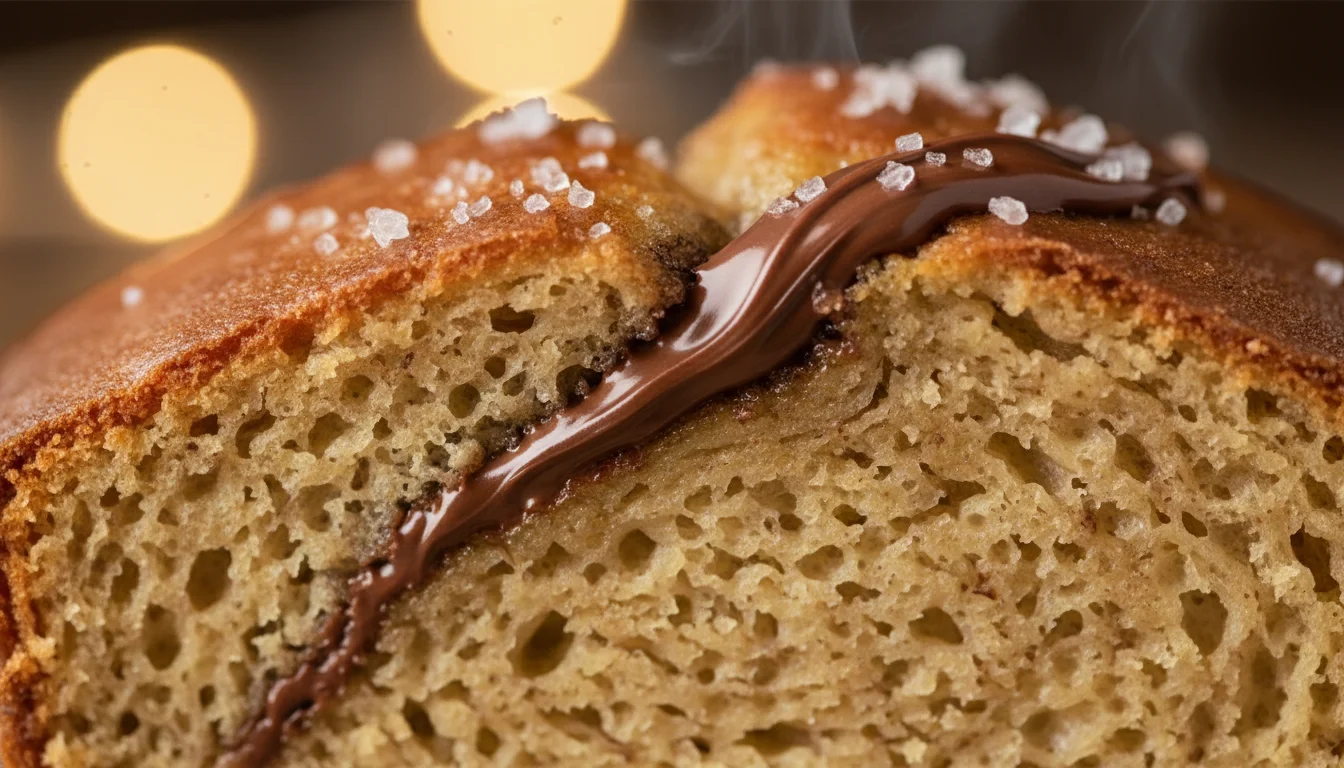
Notice in the texture above how the crumb is tight yet moist? That is the result of minimizing gluten development. We want a "short" bite, not a chewy, bread-like elasticity.
Ingredient Intel: Beyond the Basics
To achieve professional results, ingredient state is just as important as ingredient quality.
- Bananas (The Sugar Vehicle): You want bananas that are more black than yellow. As a banana ripens, its starch converts to simple sugars (fructose and glucose). This increases sweetness and moisture. If your bananas are yellow, wait.
- Light Brown Sugar vs. White Sugar: We use primarily brown sugar here. It contains molasses, which adds acidity (activating the baking soda) and retains moisture far better than granulated white sugar.
- Room Temperature Eggs: Cold eggs shock the melted butter, causing it to re-solidify into grainy chunks. Room temperature eggs emulsify smoothly, creating a uniform lattice for the flour to suspend in.
- The Hazelnut Spread: Brand matters less than texture. Whether it’s Nutella or a high-end artisan spread, it must be warm enough to flow but not hot enough to cook the eggs in the batter on contact.
Troubleshooting: The Quick-Bread Matrix
Even the best bakers encounter oven anomalies. Here is your rapid-response guide to fixing common banana bread failures.
| Issue | The Scientific Cause | The Fix |
|---|---|---|
| The "Sinking" Swirl | The Nutella was too dense compared to the batter, or the batter was too airy. | Warm the Nutella slightly to match batter consistency. Do not over-beat the eggs (too much air makes the batter weak). |
| Gummy/Wet Center | High sugar content draws water, making evaporation difficult; or simply underbaked. | Cover with foil after 40 mins to prevent burning, but keep baking. Check internal temp: aim for 200°F-205°F (93°C-96°C). |
| Tough/Chewy Texture | Gluten over-development. | Stop mixing the moment the flour streaks disappear. There should be lumps! Lumps are good. |
| Cracked Top | This is actually desirable! It releases steam. | If the crack is too aggressive/side-ways, your oven temp is too high. Verify with an oven thermometer. |
The "Art of the Swirl" Technique
The difference between a messy loaf and a masterpiece is the Action of Marbling. Many home cooks over-swirl, trying to distribute the chocolate everywhere. This is a mistake.
You want ribbons, not a mixture.
Sarah's Protocol:
- Pour 2/3 of the batter as a base.
- Add the Nutella.
- Add the remaining batter.
- Insert a knife vertically.
- Move in "S" curves or Figure-8s. Do this only 3 or 4 times down the length of the pan. Stop.

Less is more here. When you slice into the cooled loaf, those distinct, unmixed veins of chocolate provide a textural variety that makes this recipe a true crowd-pleaser. Enjoy the science of baking!