The Ultimate Leavening Showdown: Baking Soda vs. Baking Powder for Sky-High Bakes
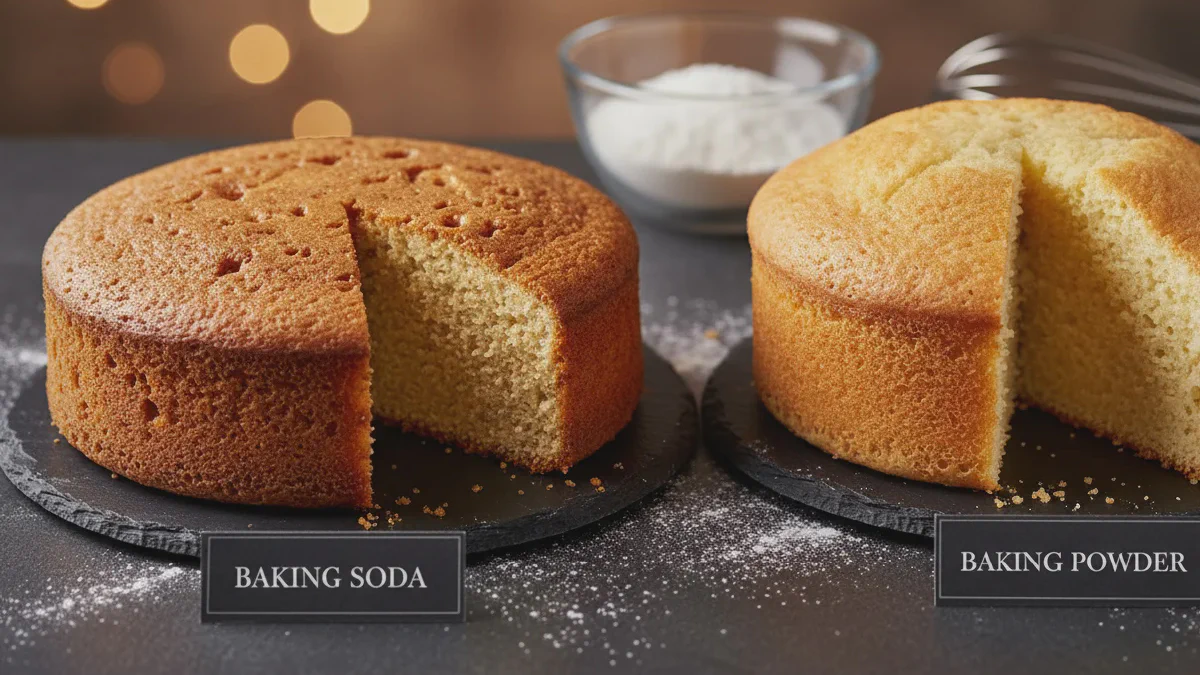
Unlock the chemistry of the perfect crumb. Culinary Scientist Sarah Baker reveals exactly when to use soda vs. powder to prevent flat cakes, bitter metallic tastes, and guarantee maximum rise.
We have all been there. You pull a tray of muffins out of the oven, expecting bakery-style domes, but instead, you are greeted by sad, dense pucks. Or perhaps you’ve bitten into a biscuit that tasted inexplicably like cleaning detergent.
The culprit isn’t usually your oven or your flour—it’s the chemistry.
As a culinary scientist, I treat baking not as magic, but as a series of chemical reactions that we can control. The battle between Baking Soda (Sodium Bicarbonate) and Baking Powder is the most misunderstood rivalry in the kitchen. They both create Carbon Dioxide ($CO_2$), but how they get there—and the texture they leave behind—is completely different. Let’s decode the science of the rise so you never bake a flat cake again.
The Architecture of Aeration: Creating the Perfect Crumb
To understand “lift,” we have to look at the microscopic level. We aren’t just making food; we are engineering a sponge. When your leavening agent reacts, it releases gas bubbles. These bubbles get trapped in the gluten network of your flour, expanding as the heat rises.
If the reaction happens too fast, the bubbles burst before the cake sets (collapse). If it happens too slow, the crust hardens before the center rises (dense texture).
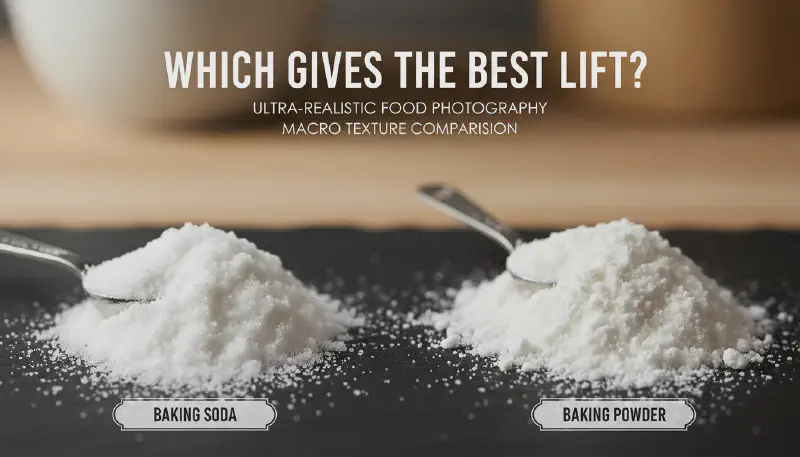
Above: Notice the difference in pore size. A balanced pH reaction creates the tender, even crumb on the left, while an over-leavened batter creates the chaotic, tunneling structure on the right.
The Sodium Showdown: Pure Power vs. Controlled Lift
Here is the definitive breakdown of our two contenders.
1. Baking Soda (The Powerhouse)
Chemical Name: Sodium Bicarbonate ($NaHCO_3$). The Personality: It is a base (alkaline). It is needy. It requires an acid to work. The Trigger: As soon as it touches moisture and acid (buttermilk, yogurt, lemon juice, molasses, brown sugar), it reacts instantly. The Catch: Because it reacts immediately, you must get the batter into the oven right away. It is also roughly 4x stronger than baking powder. Best For: Spreading cookies (it weakens gluten) and neutralizing acidic flavors.
2. Baking Powder (The Reliable Assistant)
Composition: Baking Soda + Acid (usually Cream of Tartar) + Cornstarch (buffer). The Personality: It is self-contained. It carries its own acid. The Trigger: Most modern powders are “Double Acting.”
- First Rise: Happens when wet ingredients hit the dry mix.
- Second Rise: Happens when the heat of the oven hits the batter. Best For: Cakes and muffins where you want a fluffy, vertical rise rather than spread.
The Ultimate Leavening Showdown: Baking Soda vs. Baking Powder for Sky-High Bakes
Ingredients
Instructions
- The dry Mix: In a large bowl, whisk together flour, sugar, salt, and your chosen leavening agent. If testing Baking Soda, ensure you use 1/4 tsp soda plus an acidic liquid. If testing Baking Powder, use 1 tsp powder.
- The Emulsion: In a separate jug, whisk eggs, oil, milk (or buttermilk), and vanilla until fully emulsified.
- The Fold: Pour wet ingredients into dry. Fold gently with a spatula only until no flour streaks remain. Do not overmix, or you will toughen the gluten.
- The Bake: Fill muffin tins 3/4 full. Bake at 400°F (200°C) for 15-18 minutes until golden and domed.
The Diagnostics Lab: Why Your Bake Failed
When things go wrong, the texture tells the story. Use this troubleshooting matrix to diagnose your leavening errors.
| The Issue | The Chemical Cause | The Fix |
|---|---|---|
| Soapy/Bitter Taste | Excess unreacted Baking Soda. | Reduce soda or increase the acidic ingredient (e.g., switch milk to buttermilk). |
| Cratered Center | Too much leavening gas produced too quickly. | The structure collapsed. Reduce leavening agent by 10-15%. |
| Dense/Heavy Texture | Expired leavening or over-mixing. | Check expiration dates. Fold gently to keep gas trapped. |
| Pale Crust | Too acidic (pH is too low). | Baking soda aids browning (Maillard reaction). Add a pinch of soda to aid browning. |
| Tunnels/Large Holes | Rapid reaction + Over-mixing. | Don’t beat the batter once the leavener is added. Mix until just combined. |
Sarah’s Secret Vault: The Fizz Test & Beyond
Professional bakers don’t trust dates stamped on a tin; we trust chemistry. Humidity kills leavening agents long before their expiration date. Before I start any high-stakes baking project (like a wedding cake or a soufflé), I perform the Vitality Test.
How to Test Your Agents:
- For Baking Soda: Drop 1/2 teaspoon into a small bowl of vinegar or lemon juice.
- For Baking Powder: Drop 1/2 teaspoon into a small bowl of hot water.
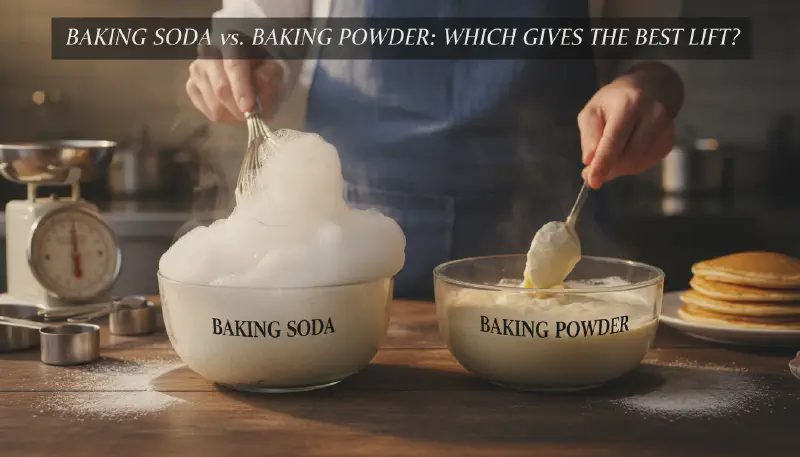
If the mixture bubbles violently (like a science fair volcano), your leavener is active and ready to provide maximum lift. If it just sits there or fizzes weakly, toss it. It is not worth ruining your ingredients over a $2 tin of powder.
Pro-Tip: If a recipe calls for both powder and soda, it usually means the soda is there to neutralize an acid (like yogurt) for flavor, while the powder is doing the heavy lifting for volume. Never skip one thinking the other will cover for it!
The Ultimate Leavening Showdown: Baking Soda vs. Baking Powder for Sky-High Bakes
Ingredients
Instructions
- The dry Mix: In a large bowl, whisk together flour, sugar, salt, and your chosen leavening agent. If testing Baking Soda, ensure you use 1/4 tsp soda plus an acidic liquid. If testing Baking Powder, use 1 tsp powder.
- The Emulsion: In a separate jug, whisk eggs, oil, milk (or buttermilk), and vanilla until fully emulsified.
- The Fold: Pour wet ingredients into dry. Fold gently with a spatula only until no flour streaks remain. Do not overmix, or you will toughen the gluten.
- The Bake: Fill muffin tins 3/4 full. Bake at 400°F (200°C) for 15-18 minutes until golden and domed.
Nutrition
Calories: 185 kcal | Protein: 4g | Fat: 8g | Sugar: 12g